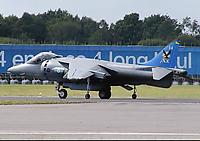
 The British Aerospace Harrier is used by the RAF in the close air support role. In this, aircraft are usually employed in direct support of ground troops tackling such targets as enemy troop positions, tanks and artillery.
The Harrier uses a variety of weapons such as laser and GPS-guided bombs against buildings (Paveway), infra-red missiles against tanks (Maverick), cluster munitions and general-purpose bombs.
When required, the Harrier can also be fitted with a pod fitted with cameras to provide reconnaissance of the target and battle areas.
The first Harriers entered RAF service in 1969, making the RAF the first in the world to use its revolutionary vertical take-off and landing abilities which allow the aircraft to fly in and out of areas close to the battlefield that would normally be off-limits to conventional aircraft such as the Tornado. The current versions of the Harrier are the pilot-only GR7 (which is being upgraded with more powerful engines and electronic systems to become the GR9) and the two-seat T10 which, when not used as a training aircraft, can also be used in combat.
Since 2000, the RAF's Harrier and the Royal Navy Sea Harriers have been under the organisational control of Joint Force Harrier. This has seen the RAF's aircraft deploy alongside the Sea Harriers on board aircraft carriers of the Navy on many routine training deployments as well as operations.
| Specifications
Engine: One Rolls-Royce Pegasus vectored thrust turbofan. Mk 105 (GR7, GR9, T10, T12) Mk 107 (GR7a, GR9a) Length (GR7, GR7a, GR9): 46ft 4in (14.12m) Length (T10, T12): 55ft 7in (17m) Height (GR7): 11ft 4in (3.45m) Height (T10): 13ft 7in (4.17m) Wingspan: 30ft 4in (9.24m) All Up Operational Weight: Approx 13,494 kg Ferry Range (with 4 x drop tanks) 5,382 km (3,310 miles) Top Speed: 673 mph (1,083 km/h) Accommodation: Crew of 1 (GR7, GR7a, GR9, GR9a) or 2 (T10, T12) Available Armaments: (7 fixing points)
|
 |
(1) Air Interdiction (AI). Low- or medium-level attacks using precision-guided, freefall or retarded bombs.
(2) Close Air Support (CAS). Air attacks against hostile targets that are in close proximity to friendly forces.
(3) Reconnaissance.
Recognition
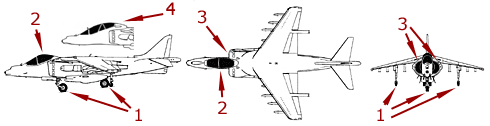
The sharply downward-sloping wing and tailplane, and the large air intakes of the Pegasus engine (3) make the Harrier very distinctive. The undercarriage is also unusual, in that the main wheels and nose wheel retract in tandem into the fuselage and there are two outrigger wheels that retract into housings on the wing at about two-thirds span (1). The cockpit glazing is large and pronounced on all versions(2). The T10 has a much more pronounced 'hump' for the twin cockpit (4) and is slightly longer than the GR7.