(6) - Food
 Prepare your meal as soon as you can. Not only will you feel the warming effects of the food, but the morale boosting features of a good feed cannot be understated. Ration out your food thoughtfully, and make sure you have enough to last at least 24 hours. Once you have settled into your routine and awaiting rescue, you can consider catching your next meal, by fishing, snaring or collecting. Prepare your meal as soon as you can. Not only will you feel the warming effects of the food, but the morale boosting features of a good feed cannot be understated. Ration out your food thoughtfully, and make sure you have enough to last at least 24 hours. Once you have settled into your routine and awaiting rescue, you can consider catching your next meal, by fishing, snaring or collecting.
 Never leave a meal cooking while you do something else unless it is totally unavoidable. If there is more than one of you camping out, one person should be put in charge of food preparation and water collecting - and nothing else! A spoilt meal is almost as bad as no meal at all, not only is it a waste of valuable resources, but your morale will sink to an all-time low as a result. Never leave a meal cooking while you do something else unless it is totally unavoidable. If there is more than one of you camping out, one person should be put in charge of food preparation and water collecting - and nothing else! A spoilt meal is almost as bad as no meal at all, not only is it a waste of valuable resources, but your morale will sink to an all-time low as a result.
If you want to be the most popular person in the campsite, just shout 'Grub's up!' and see the reaction you get from your fellow survivors! Make a fresh cup of tea with every meal (not coffee as it will make you more thirsty), as this is the time to organise the next part of your survival plan when everyone is relaxed, warm, thinking clearly and fed!
(7) - Knives
  Caution! Carrying knives in a public place without a good reason is a criminal offence. There are also age limitations plus you may be asked to justify carrying an offensive weapon at any time. Caution! Carrying knives in a public place without a good reason is a criminal offence. There are also age limitations plus you may be asked to justify carrying an offensive weapon at any time.
Survival knives are as numerous in design as they are in price and quality. The picture below shows a typical 'survival knife' available from specialist or camping shops with a pointed swage, full length tang (the elongated metal part that is enclosed by the handle), and a saw blade on the opposite side to the blade.
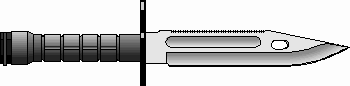 A riveted rectangle handle is not necessarily the very best design as the rivets can injure your hand with constant use, and the shape will not offer the best grip in the palm. The ideal shape is oval, and the best material is wood. Metal handles are difficult to control when wet, and in extreme climates such as the arctic, metal becomes brittle plus there is always the danger of touching freezing metal with exposed skin (it sticks!). A riveted rectangle handle is not necessarily the very best design as the rivets can injure your hand with constant use, and the shape will not offer the best grip in the palm. The ideal shape is oval, and the best material is wood. Metal handles are difficult to control when wet, and in extreme climates such as the arctic, metal becomes brittle plus there is always the danger of touching freezing metal with exposed skin (it sticks!).
It is important to get a knife with a full length tang as this makes the whole assembly stronger, especially for hard work such as chopping. The handle should be large enough to fit comfortably in the hand without having to grip too tightly, a small handle is not only difficult to control, but will cause blisters.
Avoid the use of 'Rambo' style knives with the hollow handle (generally containing survival gear such as matches, mini compass etc.) as they are usually weaker than the solid handle designs and can be made of plastic.
The basic rule of thumb is select a knife for a specific task, this may mean carrying more than one knife, one for woodwork, one for skinning and one for intricate work such as carving.
| 







